
All Posts By

DealerOn

DealerOn, Inc. is a premier website and digital marketing company serving the retail automotive industry. In the last 12 months DealerOn’s websites have won virtually every meaningful industry award including: Driving Sales Top-Rated Website, Digital Dealer’s Overall Website Excellence Award, AWA’s Pinnacle Award, and Dealer Marketing Magazine’s Technology Award for Website Providers. DealerOn has become noted in the industry for their Lead Guarantee, based on their Digital Marketing Dashboard. Since creating this process in 2009, DealerOn has documented an average increase of over 200% in website lead volume for their auto dealer clients. To learn more about DealerOn’s Lead Guarantee, visit our website here.

Google’s Panda Update Hits Press Release Effectiveness

Many small businesses, including car dealerships, use press releases as a way to add to their search engine optimization. In fact, 3 years ago, DealerOn even recommended dealerships use a press release strategy. However, with Google’s recent algorithm changes, press release sites no longer have the search engine benefits they once did, unless and until they are able to fix some pretty big flaws in their design.

press releaseDuring Google’s Panda update, the search engine giant used human reviewers to determine the quality of a set of websites. They took that data, plugged it into their patented machine learning technology, and used that to update their algorithm. Google provided these examples of questions their testers were answering about websites:

  • Would you trust the information presented in this article?
  • Is this article written by an expert or enthusiast who knows the topic well, or is it more shallow in nature?
  • Does the site have duplicate, overlapping, or redundant articles on the same or similar topics with slightly different keyword variations?
  • Would you be comfortable giving your credit card information to this site?
  • Does this article have spelling, stylistic, or factual errors?
  • Are the topics driven by genuine interests of readers of the site, or does the site generate content by attempting to guess what might rank well in search engines?
  • Does the article provide original content or information, original reporting, original research, or original analysis?
  • Does the page provide substantial value when compared to other pages in search results?
  • How much quality control is done on content?
  • Does the article describe both sides of a story?
  • Is the site a recognized authority on its topic?
  • Is the content mass-produced by or outsourced to a large number of creators, or spread across a large network of sites, so that individual pages or sites don’t get as much attention or care?
  • Was the article edited well, or does it appear sloppy or hastily produced?
  • For a health related query, would you trust information from this site?
  • Would you recognize this site as an authoritative source when mentioned by name?
  • Does this article provide a complete or comprehensive description of the topic?
  • Does this article contain insightful analysis or interesting information that is beyond obvious?
  • Is this the sort of page you’d want to bookmark, share with a friend, or recommend?
  • Does this article have an excessive amount of ads that distract from or interfere with the main content?
  • Would you expect to see this article in a printed magazine, encyclopedia or book?
  • Are the articles short, unsubstantial, or otherwise lacking in helpful specifics?
  • Are the pages produced with great care and attention to detail vs. less attention to detail?
  • Would users complain when they see pages from this site?

So how does this impact press release publishing sites? Search Engine Land and Seer Interactive both conducted studies showing major press release sites have seen a major dip in traffic following Panda. Moz.com recently dove into a couple of the biggest issues PR aggregators could be having with the “test” questions above:

Does This Site Contain Insightful Analytics?
Typically, users don’t go to a press release website to find information. Often times, press releases are considered a necessary evil for SEO purposes, so the content isn’t thoughtful or insightful. PR websites may struggle to combat this issue as part of their appeal is lack of editorial edits to content.

Do You Consider This Site an Authority?
Because PR aggregators have a lot of information about a lot of different things, it’s difficult for them to rank high for this question.

Would you Share or Bookmark This Site?
Chances are, unless your press release is exceptionally newsworthy, it’s unlikely to be shared or bookmarked. Consider the amount of non-newsworthy press releases gathered on PR portal sites, and you can see why they may not rank well for this question.

If your dealership or SEO agency continues to use press releases as a part of your SEO strategy, consider adding graphs, charts, and images to help increase the “insightfulness” of your content. Release information when it’s truly newsworthy, and provide information that people may want to share with their friends and colleagues. Also, industry specific press release portals may have less of a chance of being affected by this Panda update, and thus giving your content a better chance of ranking well on Google’s SERP.

Take a look through the questions provided by Google. How would your car dealership website do? Use these as a guideline to providing quality content to search engine users. This is the direction Google is headed.


Google Helps Your Dealership “Settle the (Quality) Score”

Google Adwords is probably one of your dealership’s biggest and most important online marketing investments. Even if your dealership has hired an agency to manage your investment, you should spend 15 minutes to read the information Google just put out on Quality Score.

Quality Score (QS) can be one of the more confusing aspects of Google’s Adwords algorithm, but its critical to optimizing your dealership’s Adwords account. As a part of their AdWords Best Practices Series, Google released “Settling the (Quality) Score” white paper to help small businesses understand QS.

Google repeatedly states that the Quality Score number that appears in your Adwords account is not actually used in the real-time ad quality calculations. The Quality Score figure is a simplified representation of three factors: 1) ad relevance, 2) expected Click-Through-Rate (CTR) and 3) landing page experience, that Google does use in its calculation. According to Google, the Quality score is the “warning lights in a car: something that alerts you to potential problems.”

Anyone who is familiar with Adwords already knows that for every Keyword in your account, Google provides ratings (Above Average, Average, and Below Average) for each of these 3 elements. Ideally your keywords will be “Above Average” for all of them. In the Quality Score White Paper, Google even provides specific actions you can take to improve your score for any of these three factors.

Another interesting part of this whitepaper discusses a few things that DO MATTER and those that DON’T MATTER when it comes to Quality Score.

DOES MATTER:

  1. The User’s Device – it matters to Google that you are giving users a good experience, and that includes catering to the device they are using to view your ads. Make sure your website is optimized for mobile users. Try separate ads and pages for mobile visitors.
  2. Relevance to a User’s Intentions – Google believes this is the “heart of ads quality.” “Focus on delivering relevant ads” instead of trying to game the system for a higher QS.
  3. For Newly-Launched Keywords, Performance on Related Keywords – Google will see how well the ads and pages are performing on related keywords if you’re starting out with new keywords. This prevents them from having to measure from scratch, and gives you an opportunity to start off on a good foot.

DOESN’T MATTER

  1. How You Structure Your Account – Your AdWords account should be structured in a way that makes sense for you and your dealership. Outside of that, moving a keyword into a new ad group or campaign (without changing the ad text or destination URL) will not have an impact on your Quality Score.
  2. Running Your Ads in Other Networks – Using the Google Display network or other Google search partners won’t affect the quality of your ads on Google.com.
  3. Your Ad’s Placement on the Page – Having your ad in a high position on the page is great, but it doesn’t increase the expected Click-Through-Rate of your ads. The expected CTR shown is normalized for your actual position.

This white paper is a great resource for those dealerships that manage their own PPC accounts, and even for those trying to understand how their vendor is earning their ROI. I highly recommend reading through the ten page document when you have time. The biggest takeaway? “Give your users what they need, and a great Quality Score should follow.”

Tweet or Tweet Not, There is No Try

If you’re new to Twitter, let me be the first one to welcome you to 2007. Actually, Twitter officially launched in the summer of 2006, and has steadily grown into a social network with 255 million active monthly users. Twitter’s mission is to give everyone the power to create and share ideas and information instantly, without barriers. Think about that.

Don’t underestimate the power Twitter provides its users.

  • 500 million tweets are sent every day
  • 78% of active Twitter users are on a mobile device
  • 585 gallons of coffee are consumed every week at Twitter’s HQ

Isn’t Twitter A Waste Of Time?

Yes, it is for a lot of people, but don’t follow them. Literally, don’t follow their methods and motivations for using Twitter. Anyone can jump on Twitter and start barking about how their company, product, service or event is better than all of their competitors. In the automotive industry, you’ll find people using Twitter like a bully pulpit on a daily basis. Pay no attention to those annoying wind- bags and their intentionally destructive behavior. The same people that talk big through a keyboard and an email address are 100x worse on Twitter, so don’t listen to them. The truth is, Twitter offers a wealth of information and is largely an unknown opportunity for car dealers.

Invitation, Encouragement, Recommendation

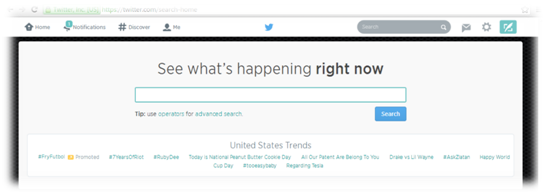
I’m a big fan of experience, so I want to invite and encourage you to experience Twitter. You should experiment with how to “Tweet” and “Follow” people and businesses, but I think you’ll see true value for your dealership with one of my favorite Twitter features. Search. Real time information at your fingertips. If you’ve never used this feature, jump online and go to search.twitter.com. It should look like this:

Twitter Search Operators

You may want to briefly study these Twitter Search Operators. They will help you find very specific information. I know some of you literally just gave up because it sounds like homework and you don’t care to make the effort. Can I encourage you? This is how the “experts” in the automotive industry become experts. They find the information, they immerse themselves and they gain experience by using, testing, learning and doing it over and over again. Become an expert yourself and cut some of your dependency on the “experts”.

Operator Finds Tweets…
Twitter search Containing both “twitter” and “search”. This is the default operator
“new car” Containing the exact phrase “new car”
Toyota OR Dealer Containing either “Toyota” or “Dealer” (or both)
Beer –root Containing “beer” but not “root”
#newcar Containing the hashtag #newcar
From: mashable Sent from “shaunraines”
To: dealeron Sent to “dealeron”
@techcrunch Referencing “dealerauthority”
“new car” near:”dallas” Containing exact phrase “new car” and sent near “dallas”
Near:dallas within:15mi Sent within 15 miles of Dallas
Superhero since:2010-12-27 Containing “superhero” and sent since date “2010-12-27” (year, month, day)
Ftw until:2010-12-27 Containing “ftw” and sent up to date “2010-12-27”
Movie –scary 🙂 Containing “movie”, but not “scary”, and with a positive attitude
Dealership 🙁 Containing the word “dealership” and with a negative attitude
Traffic ? Containing “traffic” and asking a question
Hilarious filter:links Containing “hilarious” and linking to URLs
News source:twitterfeed Containing “news” and entered via TwitterFeed

Still Skeptical?

It took me a few years to warm up to Twitter, so I can appreciate those of you who are skeptical. Maybe you’re one of the people that don’t really know how Twitter works or how to use it. If you’re in need of Twitter 101, the best place learn is directly from Twitter.

For the Twitter basics, visit https://support.twitter.com/articles/215585. You’ll find-out what Twitter is, how to use it, tips and tricks, the official Twitter glossary and a lot more. Twitter’s support actually has tons of excellent insight and information. You can become a Twitter expert in the quietness of your home or office without feeling embarrassed or shy to ask some self-made automotive Twitter expert a single question. How’s that for a slice of fried gold? Explore, learn, enjoy and thank me later.

Will It Help Me Sell More Cars?

You had to ask, didn’t you? Well, in case you don’t find it easily during your first visit to support.twitter.com, you’ll want to check out this case study https://business.twitter.com/success-stories/zender-ford. If you’d like more automotive specific Twitter examples, you can find them here https://business.twitter.com/success-stories/industry/automotive.

So Tweet it up and have fun.

If you liked this article, “Follow” me @shaunraines and let me know.

How to Build Trust With Service Customers From the Start

The fixed operations department in the average dealership generates over 50% of a typical dealer’s  gross profit, according to NADA. Since this is where you make most of your money, it’s important that you do everything you can to turn each and every visitor to your service lanes into loyal, return customers. While your fixed ops staff may have a game plan once those customers visit your service department, how can you influence their opinion of your dealership from their first interaction online?

Whether you have a dedicated service website or are making the most of the service pages on your traditional website dealership site, here are some tips to use the online presence of your service department to help instill trust before customers get into your service lane.

Build Trust From the Start – When a potential customer interacts with a call to action on your website, make sure your dealership staff responds in the way that is promised. Did they request a service appointment? Ensure the email/phone call references the information your potential customer has already volunteered.

Show Them Your Staff – Let service customers see a familiar face when they come into your service lane. Maintain your dedicated staff page and add a little bit of information about each technician. This could include their certifications and years of experience. This may help visitors build a connection with your staff before they walk in the door.  Another benefit of posting your service techs certifications and qualifications on your website also builds value for using YOUR service department as opposed to one of the national service brands that don’t have staff with comparable levels of experience and expertise.

Give a “Walk-Through” Online – Post pictures of your service department as well as what to expect from a typical service appointment. Help potential customers feel more comfortable choosing your dealership’s service department by showing them around online.

Help Keep Them on Track – Does your website have scheduled maintenance information readily available? This type of information helps set your dealership website apart from the national service brands, and helps build trust with potential consumers. Try adding videos explaining what will happen at each interval for added benefit.

Make It Easy – Reduce as much friction as possible through your website. Are your service hours accurate? Does your service scheduler work properly if your dealership offers one? Do you offer loaner vehicles or is there a shuttle service? Try to answer typical questions online.

If your fixed ops website can make your service customers comfortable before they visit your service department, you’re one step ahead in converting that quick oil change into a lifelong service customer.

How to Use Google Analytics Reports to Speed Up Your Website

We all know that one of the most important traffic sources for the typical car dealer website is Google’s organic search listings.  Google has made it very clear that one of the most important factors in determining where your dealership’s website content ranks on Google is the speed at which that page loads for their users.  Google has stressed that the page load time is an EVEN bigger factor for mobile rankings than for traditional desktop search results.  Did you know that Google Analytics has a Site Speed Page Timings report that shows you the speed for EVERY page on your site in one easy report?

Over the last few weeks, we have written about Google’s site speed insight tool that can show you or your website provider how to lower the load time of a particular page on your site.  But how can you get information about which pages you should check?  The Google Analytics Site Speed Page Timings report shows you Google’s calculated load time for EVERY page on your site, along with the amount of traffic each page receives, and what the Bounce Rate is for that page!


Page Timings Report:

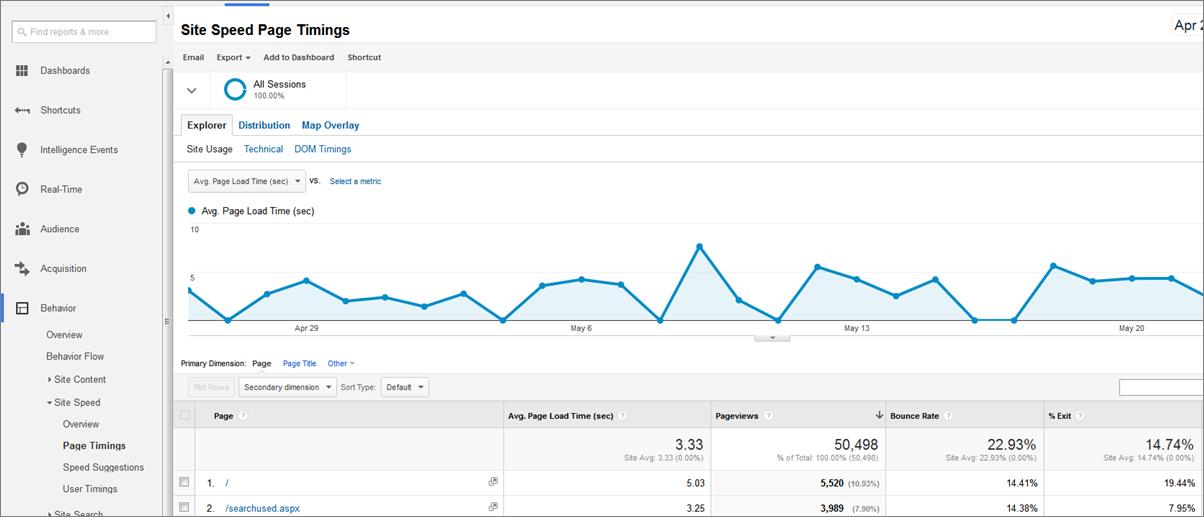
Here is an example of the Google Analytics Page Timings report.  To access the report in your Google Analytics account, just click through on “Behavior>Behavior Flow>Site Speed>Page Timings”.  You will get a report that looks like this:

For every page on your site, the report shows:

  1. The time it take to load the page in Seconds
  2. The # of page views during the time period for which you’ve run the report
  3. The Bounce Rate for the page
  4. The Exit Rate

If you use the sort functionality within the report, you can focus on the pages with the highest Load times, the Most Traffic, or the highest Bounce Rates.  You can easily identify the highest trafficked pages on your site that also have high Bounce Rates, and see if the load times for those pages are part of the Bounce Rate problem.

You can even filter this report to just show Organic Search traffic and use “Landing Page” as the Primary Dimension, which will then show you the actual load time for consumers coming to your website from Google or Bing.  Because you also have the Page Views, you can easily focus on the pages with High Load Times, High Bounce Rates and High Traffic volumes, helping you to get the most return from your time investment.

Because page speed is an even more critical SEO factor for mobile, this report REALLY becomes valuable if you filter the traffic to show only Mobile Visitors.  When you create a report that shows pages that have lots of traffic, high bounce rates, and high load times for Mobile traffic, you can use the Google PageSpeed Insights Tool to get actionable information on how to speed up the pages that will provide the most value to your dealership if you optimize them (because they have the most inbound traffic).

If you are investing a material amount of money in paid search advertising, you should run this same report, filtered on your paid search traffic.  You can then isolate any landing pages that are problematic from a Speed/Bounce Rate view.  Once you’ve isolated the problem landing pages you could send the traffic to a similar, but faster landing page with a lower bounce rate, invest some time in fixing the current landing page, or pause the campaign until you have time to improve your results.


Speed Suggestions Report:

If you just want to see a list of pages with their accompanying Google Page Speed scores, you can click on the “Speed Suggestions” report just below the “Page Timings” report and get a list of all the pages in your site, sorted by Page views, with the accompanying Google Page Speed score (0-100) and a link to the Google Insight suggestions for improving the page speed.

Google is continuously improving Google Analytics to provide insight into how Google evaluates your site’s content for its organic search rankings and paid search traffic.  Make sure that you aren’t overlooking this free tool that can help you, your website provider, your SEO guru, or your paid search vendor maximize your dealership’s return on their time and efforts.

Call support
(877) 543-4200
Call Sales
(877) 543-6321