The Difference a Combination Can Make

In the seven years I’ve been in the automotive industry, I’ve noticed that much of the thinking tends to be segmented – Internet Dept vs. Showroom, New vs. Used, Sales vs. Service. A lot of times, this way of thinking rolls over to the advertising and marketing your dealership does, including that of your vendors – Paid vs. Organic, Digital vs. Traditional, Print Vs Online.


Many industries suffer from this either/or mentality, but the more you can think in terms of “and” (especially in your marketing), the more successful your dealership can be. A recent Marin Software study explored the differences in online marketing campaigns that separated their search and social advertising and those that combined those marketing efforts.


Google’s “The Customer Journey to Online Purchase” found that social interactions in the path to conversion “assist” other digital channel conversions twice for each time a click on a social ad directly contributes to a conversion.  This stat alone gives cause to manage digital marketing campaigns together, not in a vacuum.


In fact, in Google’s “Digital Drives Auto Shopping” study in November 2013, they found that the average consumer has 24 research touchpoints (including Digital and offline media) in their purchase process.   The increasingly fragmented (and often lengthy) road to sale means that when you’re not tracking and managing social and search ads together, you could be missing opportunity and your true ROI.


The Marin study found two key takeaways:

  • Customers Who Click on Search AND Social Ads are More Likely to Buy
  • Customer Who Click on Your Search AND Social Ads Spend More

In fact, those that clicked on both search and social ads had a click-through rate 4X higher than those that only clicked on social ads and approximately twice the . More and more car shoppers are using search and social to find your dealership and to help choose their next vehicle.  Encouraging shoppers to interact with your ads across multiple platforms means better conversion rates and ROI for your dealership. Try parroting your social ads with search ads and vice versa; present the same branding message across both platforms to increase click through rate. Retargeting is a great example of this type of combined, cross-channel marketing.


Change your marketing focus from the medium you’re using to advertise, and combine mediums to focus on the consumer. How can you best reach your potential customers using all of your advertising options?


Interested in learning more? Check out the white paper from Marin Software, The Multiplier Effect of Integrating Search & Social Advertising, and talk to your digital marketing vendors.  Make sure that your Google Analytics accounts are set up to track multi-channel conversions.  Find out what they are doing to help your dealership reach your target audience, not just what platforms they’re running your ads on.


Help Stop Stolen Content From Outranking Your Dealership Website

It’s a pretty common practice for people to Google their own name. Sometimes out of curiosity, but sometimes to help ensure your name (or your dealership’s name) isn’t showing up on webpages you don’t want it to. You Google your dealership name to help ensure it appears where you want it to (and doesn’t where you don’t), but do you Google your dealership website’s original content?

Google is known for punishing websites that have duplicate content on their site, meaning the exact content appears on other websites. But in a recent Matt Cutts video, Google’s head of search spam announced that Google’s position has shifted and the search engine company is now making strides to group websites that have the same content, and showing the best of that group in search results. This helps them not punish sites that are validly quoting or referencing content, while still maintaining a cleaned up search results page.  That is why it’s so important to know which websites are using content that you created, especially if your dealership website is not the one of the sites chosen for display.

So how does Google know which website had the content first, which sites are using it after the fact, and whether or not the content is being used properly? No one truly knows how the Google search algorithm is written, but Google has now given us a way to let them know when you find your original content on another website without your dealership’s permission.

Go to the Google Scraper Report, enter the URL of the page on your dealer website which displays the content, the exact URL of the offending site (where your content is being used), and the search result URL that shows your website being outranked by duplicate content.  You can find these offending pages by taking portions of the content you or your advertising agency has created for your dealership website and search for it on Google using quotation marks around the phrase or sentence. The search results pages that show should display all sites that have that content on them. Are any of them outranking your dealership website? Use the Google Scraper Report to let the search engine giant know.

This is your best way of alerting Google to duplicate, SPAM filled websites that are using your original content to outrank your dealership website in the search results. It will also help Google improve their search results listings by helping to ensure the original content gets ranked above scraper sites.

The scraper tool doesn’t promise any resolution, but it’s a start. Check to make sure the content your dealership creates isn’t being used to help someone rank above you.

Don’t Neglect This Basic SEO Factor

There are thousands of things to manage in each and every dealership, including your dealer website.  So much attention is devoted to leads, conversion rate, vehicle detail pages, etc., that sometimes it’s easy to forget one of the most basic SEO factors for your website – the speed at which it loads.

According to KISSmetrics, 47% of consumers expect a web page to load in 2 seconds or less, and 40% of people will leave a website that takes more than 3 seconds to load. When you factor in the immediacy of information most Americans are used to using their smart phones and other mobile devices, are you serving your dealership’s website to potential buyers fast enough?

Why a Fast-Loading Dealership Website is Important:

Google – Google made it clear years ago that they use site speed as a ranking factor – it appears that their algorithm is designed to penalize websites that are slow to load. This gives your fast loading site a leg up on your competition in search engine results.

Visitors – A quick loading website can help reduce bounce rates and increase conversion rates. The faster your visitors are able to access the content they are looking for, the less likely they are to go to another dealership website. You’ve probably designed your dealership’s website to help visitors find the vehicle they’re interested in as quickly as possible, so make sure you aren’t slowing them up with a slow load time.


How to Tell:

There are a number of free tools online that will test how long it takes your website to load, and most offer suggestions to increase the speed. Just enter the URL you’d like to test. I’ve listed a few below, but you can search online for “site speed test” to find more.

Page Speed Insights (from Google)

Pingdom

Another, simple way to test how quickly your car dealership website is loading is to do it yourself! Use different devices (for mobile, test on both wi-fi and the mobile network) to time how quickly your website loads.  Remember that Google factors in page speed for each type of device (desktop, tablet and phone), so make sure you test the top pages on your site for each device type.


What You Can Do:

Minimize the types of files that auto-load when your site is launched – things like videos, music, or animations can slow down the initial load time. When possible, simplify the design of your website. Talk to your website provider about how their websites are structured and coded, and what they can do to help you achieve your site speed goals.

The High Cost of Poor Process

The lifetime value of a car dealership customer is between $250,000 and several million dollars.  Stay with me…

Far too many dealers are living in a bubble, knowing a lot, but doing a little.  When dealers fail to execute, the lost dollars add up quickly.  I speak with Dealer Principals, General Managers and various internet personnel on a regular basis that believe their processes are solid, only to find out the truth reveals the opposite.  Let me share with you a real world example where a lack of communication process cost a dealership a potential lifetime customer.


Toyota Dealership in Arizona

A kind, loving woman (my mom) is ready for a new car and her son (me) happens to be visiting from out of town.  She asks her son to help her through the process and her amazing (and devilishly handsome) son agrees without question.  The woman talks about a personal experience she had recently when she rented a Toyota Camry.  Since that time she has noticed more Camry’s on the road and she has browsed the internet for Toyota Camry information.  Hmm… should the rental car company get credit as the actual lead source?

Still with me?  Good, I’ll fast forward a bit.  My mom’s experience included impressions delivered by television advertising, display ads, PPC and maybe even some good old fashioned SEO, none of which were free for the dealership.  They paid for my mom’s attention and the opportunity to sell her a car.  They earned it because I went with her to pick out and purchase her new Toyota Camry.  The process was pretty smooth.  Not the best I’ve seen, but very good including how the sales person worked appropriately to encourage a woman in her sixties to write a positive review for the dealership post-purchase.  Before you give this dealership five stars, let me tell you how the movie ended.


Count the Cost

On the hood of the Camry my mom picked out was a small blemish that required a visit to the body shop.  The sales person made my mom very comfortable about how they this minor repair would be handled.  Unfortunately, reality proved him to be very wrong.  Not only did the minor repair take much longer than was promised, the dealership put 60 miles on my mom’s new Camry over a two day period, even though she was supposed have her car back the same day.  When my sweet, non-confrontational mother asked the service guy about the 60 miles, he delivered a condescending explanation of how they had to send her car out to someone else to have it fixed.  He was clearly irritated my mom would even dare to question him about the additional miles driven in her new car.  So, it wasn’t a service they performed at the dealership.  Fair enough, but that was never disclosed and people like to know what the hell you’re doing with their car.  So, guess what happened?  She will never go back there for service, will never buy another vehicle from them, and will never tell her friends anything but the truth about her experience.  No one wants that experience.

How much does the average dealer spend advertising/marketing each month?  On average, dealers pay over $600 to advertise each new vehicle they’re trying to sell.  It adds up fast!

Dealers, you spend too much money attracting potential customers to allow your sights to be set on anything but turning each one into a lifetime customer.  Process isn’t exclusive to the internet part of your business, so make sure you have established communication processes in your service and parts departments. If not, they may be sending the lifetime customers you’re earning to your competition.

Using Google Analytics to Understand Your Mobile Traffic

As of March 2014, the average car dealer website gets more traffic from mobile devices (including laptops) than from desktop computers.  Many of the dealers that we work with have no idea how their traffic breaks down between desktop, laptop, tablet, and phone.  They are used to visiting their dealership’s website on a desktop computer at the dealership or from their home at night, so they have a good understanding of how their site looks for customers using their dealership’s site on a desktop computer.  But most dealers don’t spend enough time understanding the mobile customer experience on their website.

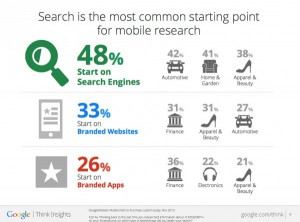
According to Google, search is the most common starting point for mobile research. In fact, 42% of automotive shoppers start on search engines, while 27% of automotive shoppers start on branded websites. Those are both huge percentages of people looking for your dealership online – but how do you know if your mobile site is delivering what they need?

The best way to learn whether or not your dealership mobile website solution, regardless of which technology platform you’re using, is meeting the needs and expectations of your visitors is to use Google Analytics. GA data can help you determine if your adaptive website design is set up properly. For example, if mobile traffic is visiting traditional, desktop pages, you have a problem with your adaptive design or switchboard tags. Do you have a disproportional bounce rate on your mobile site? This could indicate that your website isn’t showing properly to mobile visitors.

DealerOn has talked before about the importance of having Google Analytics on your dealership website, and how to use that data to sell more cars, but with the drastic shift to mobile internet usage, dealers need to make sure that their website provider has coded their site so they can easily measure site performance on mobile vs. desktop vs. tablet at a minimum.

It’s also important to understand how to analyze your website data differently for traditional and mobile website visits. Your dealership should probably be tracking different KPIs for mobile traffic than you do for desktop.  For instance, some of the most common and important KPIs for desktop traffic are:

  • Bounce Rate
  • Time on Site
  • Pages per Visit
  • VDP’s per Visit
  • Leads
  • Conversion Rate
  • Calls

For mobile traffic, many of these may not be appropriate.  In fact, you may just want to track things like Calls, Clicks to Maps, and Vehicle Views for your website’s mobile traffic.  Whatever KPIs you want to measure for mobile, you should make sure that you work with your website provider to set up goals that can measure each of these metrics and ideally assign a value to each of them so you can begin to measure the return on your mobile traffic.

These are the types of questions you need to talk to your digital marketing provider (or website company) about to make sure you’re getting the readily available, valuable data out of your Google Analytics.  It is no longer just a good idea to measure, analyze, and optimize your website’s mobile traffic.  In 2014, it is essential to getting the most out of your marketing budget.

Call support
(877) 543-4200
Call Sales
(877) 543-6321