AI Search Visitor Behavior

The Big Picture

AI Search Delivers Stronger Intent and Higher-Quality Engagement

AI Search may represent a small slice of dealership traffic today, but here’s what’s surprising: the shoppers it sends are often more serious and more likely to convert than those coming from traditional search. Early data shows that AI‑referred visitors behave differently — they arrive with focus, intent, and a clear sense of what they’re looking for.

In our earlier posts — AI Search Traffic: Hype vs. Reality and AIO & GEO Aren’t Replacing SEO — we explored how AI Search is reshaping early‑stage shopper behavior and which dealership pages AI tools surface most often. This post takes the next step: understanding what those AI‑driven visitors actually do once they land on your site.

DealerOn focused an internal study on a segment of our client dealership websites over a three‑month period, and the findings were significant:  AI Search delivered stronger intent and higher‑quality engagement.

Why AI Visitors Act Differently

Our internal study revealed several clear patterns in how AI‑referred visitors behave once they reach dealership websites.

1. AI Search sends visitors directly to deeper‑funnel pages

  • Across the DealerOn network, most AI‑driven visits go straight to inventory pages — Search Results Pages (SRPs) and Vehicle Details Pages (VDPs). These shoppers aren’t casually browsing; they’re already evaluating and comparing vehicles and are much closer to taking action. It’s a clear sign that AI‑referred visitors arrive with focus and purpose.

AI‑referred visitors behave like deep‑funnel shoppers, not top‑of‑funnel browsers.  They’re already comparing vehicles and evaluating options — not just exploring.

2. Structured data gives these pages an advantage

  • AI tools depend on information they can interpret clearly. Pages built with structured data (schema markup) are easier for AI systems to understand, which is why SRPs, VDPs, and model research pages show up more often in AI recommendations. That technical foundation increases visibility in AI‑powered search experiences.

3. AI visitors are intent‑driven

Traditional search is full of broad, navigational prompts like:

  • “Chevy dealer near me”
  • “best truck deals”

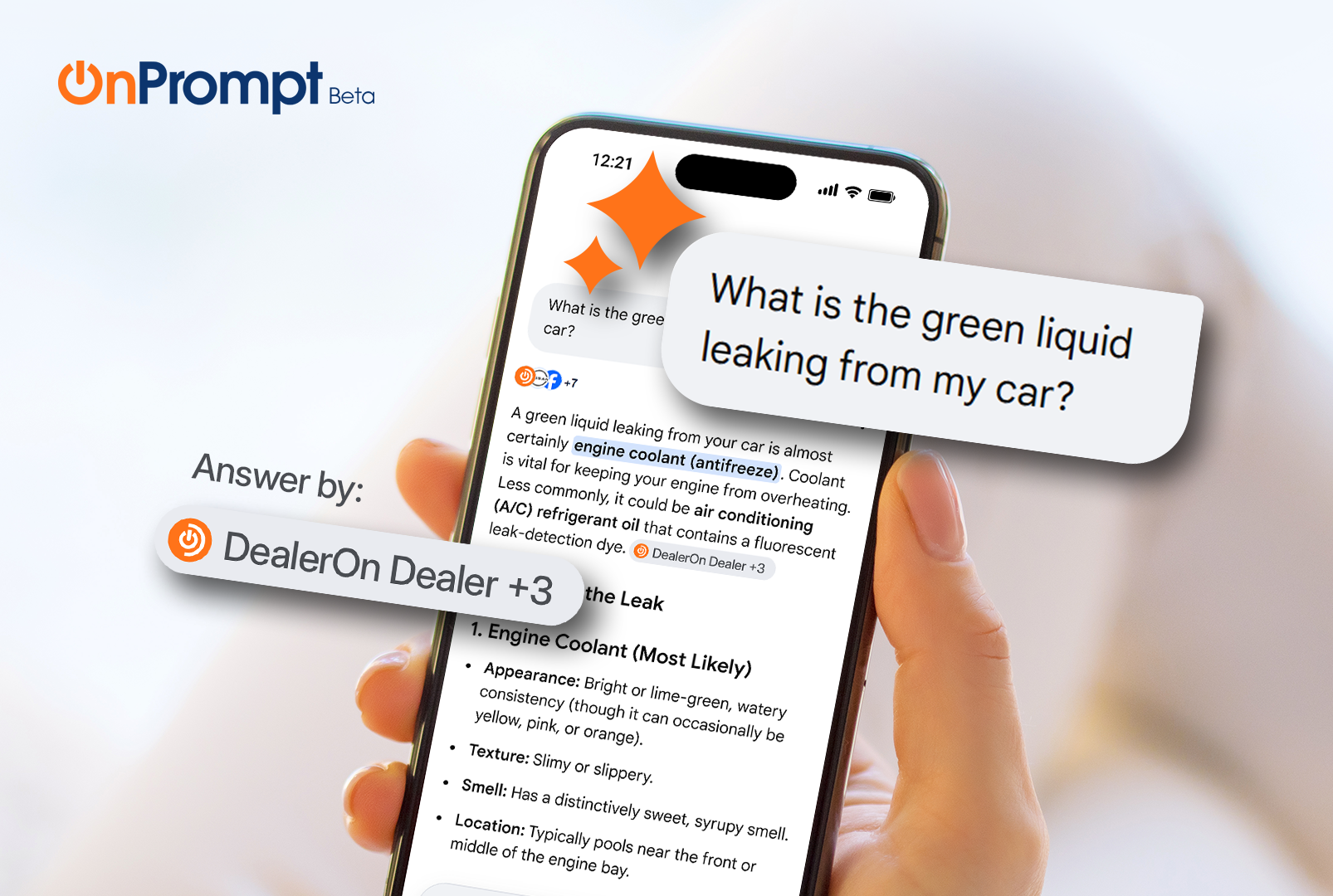
AI Search is different. Users often ask highly specific questions such as:

  • “Which Silverado seats the most people?”
  • “What truck is best for long highway drives?”

These deeper, more detailed prompts send shoppers directly to the pages that answer their questions — which explains the higher conversion rates. When they do click through to a Tier 3 dealership website, they’re already primed to act.

What This Means for Dealers

Early signals from our internal study show how shoppers are beginning their journeys and which dealership content AI tools highlight. Dealers who pay attention now can position themselves ahead of the curve.

How to Prepare

At DealerOn, our teams are focused on continuously giving our dealerships an edge. We help dealers strengthen the fundamentals that matter most in AI‑driven discovery:

  • conversational and accurate website copy
  • structured data across inventory and research pages
  • content that aligns with real shopper questions

These elements ensure that every AI‑driven visit has the best chance to turn into a lead.

Doing it yourself? Use this checklist.

If you’re tackling AI Search readiness in‑house, use this quick checklist to make sure you’re covering the essentials:

☐ Review your website copy to ensure it’s conversational, accurate, and easy for AI tools to interpret

☐ Confirm structured data is implemented across SRPs, VDPs, and model research pages

☐ Update specials, incentives, and model research pages regularly

☐ Identify which pages AI tools surface most often and optimize them for clarity

☐ Ensure your content answers real shopper questions in natural language

☐ Check that your inventory data is clean, complete, and consistently formatted

Want to measure AI‑driven leads in GA4?

Click here to talk with our team — we can walk you through how to identify AI‑driven sessions, understand their behavior, and evaluate their impact on your funnel.

Headed to NADA 2026?

Join us at the booth to explore best practices for staying ahead in the future of AI Search — and beyond. Pre‑book a demo with our team and, as a thank you, you’ll receive a $100 gift card after your session.

[Click here to reserve your strategy session now.]

AIO and GEO Aren’t Replacing SEO

When AI tools recommend your dealership, where do shoppers actually land?

As we covered in our earlier post, AI Search Traffic: Hype vs. Reality, AI Search is influencing the earliest stages of the buying journey. This post takes the next step: understanding where shoppers land once AI tools point them toward your dealership.

And here’s the surprising part: the pages AI highlights aren’t random—they’re rooted in the same fundamentals that power strong automotive SEO.

The Simple Truth

The same fundamentals that make your site strong in traditional SEO also make it visible to AI assistants. What we’re finding is that AI tools reward clear, helpful content — so the pages you already rely on for search are often the ones AI highlights too.

The industry is filled with new terms like AIO (AI Optimization), GEO (Generative Engine Optimization), and LLM optimization. With all these new acronyms, many dealers are asking whether they need completely different strategies to stay visible.

Here is the good news: No, you do not need a brand‑new strategy for AI Search.

DealerOn’s latest studies show that the best way to boost visibility in AI Search is by following the same principles that drive top‑performing automotive SEO.

AIO vs. GEO vs. SEO: What Dealers Actually Care About

SEO: Traditional Search Optimization

  • How It Shows Up for Dealers: Ranking for “Ford dealer near me” SRPs, VDPs
  • Why It Matters: Drives the bulk of traffic today

AIO: Optimizing Content for AI Assistants

  • How It Shows Up for Dealers: Better answers in ChatGPT/Gemini, etc. when shoppers ask research questions
  • Why It Matters: Build early-stage mindshare before shoppers search inventory

GEO: Optimizing for Generative Search Results

  • How It Shows Up for Dealers: Being cited or linked in AI-generated summaries
  • Why It Matters: Ensures your dealership is part of the conversation, not left out of it

Key Takeaway: AIO and GEO aren’t replacements – they’re extensions of the SEO work you should already be doing.

What We’re Seeing

  1. Inventory pages lead the way
    Most AI‑driven visits go straight to Search Results Pages (SRPs) and Vehicle Details Pages (VDPs). These pages dominate because they’re structured well and packed with the kind of information shoppers are asking for. If you want to understand why these pages perform so well, our team can walk you through the patterns we’re seeing across dealerships.
  2. Your dealership story matters
    AI tools don’t just look at cars — they look at context. Pages like About Us, Why Buy, and Meet the Team help AI understand who you are and why shoppers should trust you. When those pages are current and conversational, they carry more weight. DealerOn’s data shows that these content‑rich pages drive valuable visibility in AI Search, yet many dealerships rarely update them.
  3. Fresh content wins
    Specials, incentives, and model research pages need to stay updated. AI favors information that’s timely and useful, so stale content can cause your site to slip out of view.
  4. AI Search builds on SEO — it doesn’t replace it
    There’s no need to chase acronyms or invent separate strategies for ChatGPT or Gemini. Strong content, accurate data, and consistent updates are still the foundation. AI simply extends the reach of those efforts into new channels.

Closing Thought

AI Search is changing how shoppers discover dealerships, but the fundamentals haven’t changed: clear, helpful, updated content is what wins.

Want to dive deeper?

Click here to talk with our team at DealerOn to learn more about measuring AI Search traffic, understanding which pages AI tools surface most often, and how to strengthen your visibility across both traditional and AI‑driven search.

Headed to NADA 2026?

Join us at the booth to explore best practices for staying ahead in the future of AI Search — and beyond.

Pre‑book a demo with our team and, as a thank you, you’ll receive a $100 gift card after your session.

[Click here to reserve your strategy session now.]

AI Search Traffic: Hype vs. Reality

AI is rewriting the rules of automotive

From showrooms to search engines, it’s everywhere, and nowhere is the buzz louder than around AI Search. Headlines trumpet that ChatGPT, Gemini, Copilot, and other assistants are poised to reshape dealership traffic overnight. The narrative is dramatic: a tidal wave of digital shoppers, a sudden shift in discovery, and a looming question of readiness.

For many dealers, that hype has sparked urgency, and in some cases, anxiety about whether their stores are prepared for what’s next.

The Truth About AI Search

AI Search is growing quickly, but not in the way many dealers assume. At DealerOn, what we’re finding is that while usage is rising fast, it’s still a relatively small slice of overall dealership website traffic today. While the hype suggests an overnight revolution, the reality is more of an evolution. The bigger story isn’t found in the sheer volume of clicks; it’s in how customer behavior is fundamentally shifting.

AI Search Is Mostly Top of Funnel

AI assistants excel at broad, research-style questions, and that’s exactly how most shoppers use them. In automotive, most queries are information gathering prompts such as:

• “What SUV is easiest to fit three car seats in?”
• “Which hybrid is best for a long commute?”
• “What truck gets the best mileage?”

These prompts help shoppers narrow down needs and preferences, but they rarely send users straight to dealership websites. Queries like “Ford dealer near me” or “Toyota RAV4 for sale” are still dominated by traditional search—and will be for some time.

While these queries don’t drive clicks, they drive mindshare (the awareness and preference your dealership holds in a shopper’s mind).

AI Search Shapes Early Shopper Decisions

Even if the traffic remains small today, AI tools are already influencing what shoppers learn, which vehicles they consider, and how they frame their choices – long before they’re typing inventory-driven queries.

That makes AI Search less about chasing immediate conversions and more about ensuring your dealership is visible, relevant, and present during those crucial early research moments.

Dealers Do Not Need to Panic – They Just Need Perspective

AI Search isn’t replacing traditional search anytime soon. But it is reshaping how buying journeys begin. The real opportunity lies in understanding these shifts, aligning your content with the questions shoppers are asking, and positioning your store to be part of the conversation from the start.

DealerOn’s analysis confirms that separating hype from reality gives dealers confidence. By focusing on visibility and relevance – not fear – you can prepare for the future of search with clarity and control. Dealers who invest in visibility today are building mindshare that pays off tomorrow.

Remember: AI Search is less a revolution than an evolution – and dealers who adapt early will own the mindshare as this shift unfolds.

Want to Dive Deeper?

Click Here to talk with our team at DealerOn to learn more about measuring AI Search traffic and seeing which pages AI tools surface most often.

Headed to NADA 2026?

Join us at the booth to explore best practices for staying ahead in the future of AI Search – and beyond. Pre‑book a demo with our team and, as a thank you, you’ll receive a $100 gift card after your session. [Click here to reserve your strategy session now.]

Call support
(877) 543-4200
Call Sales
(877) 543-6321